


AWS vs Azure vs GCP vs Alibaba Cloud: Which cloud platform is best for your business?


When your business starts to scale, choosing a cloud provider is one of the most consequential infrastructure decisions you will make. AWS, Microsoft Azure, Google Cloud Platform and Alibaba Cloud each serve different workloads, compliance requirements and regional needs. This guide compares them across the factors that matter most to business and technical decision-makers: pricing, security, AI capabilities, SLAs and fit by use case.
For many businesses, this decision coincides with a wider replatforming project, which as moving from a legacy CMS, monolithic architecture or on-premises setup to a modern cloud-native environment. If that is your situation, the platform you choose will shape your migration path as much as your long-term operations. Our replatforming service covers both decisions together.
Cloud platform overview: The Big Four at a glance
What is a cloud platform?
A cloud platform delivers on-demand computing resources over the internet - servers, storage, databases, analytics, AI, and more - so businesses can run and scale apps without the cost and hassle of managing physical hardware. It powers everything from Commerce stores to enterprise-grade machine learning, all while offering flexibility and speed.
The market leaders
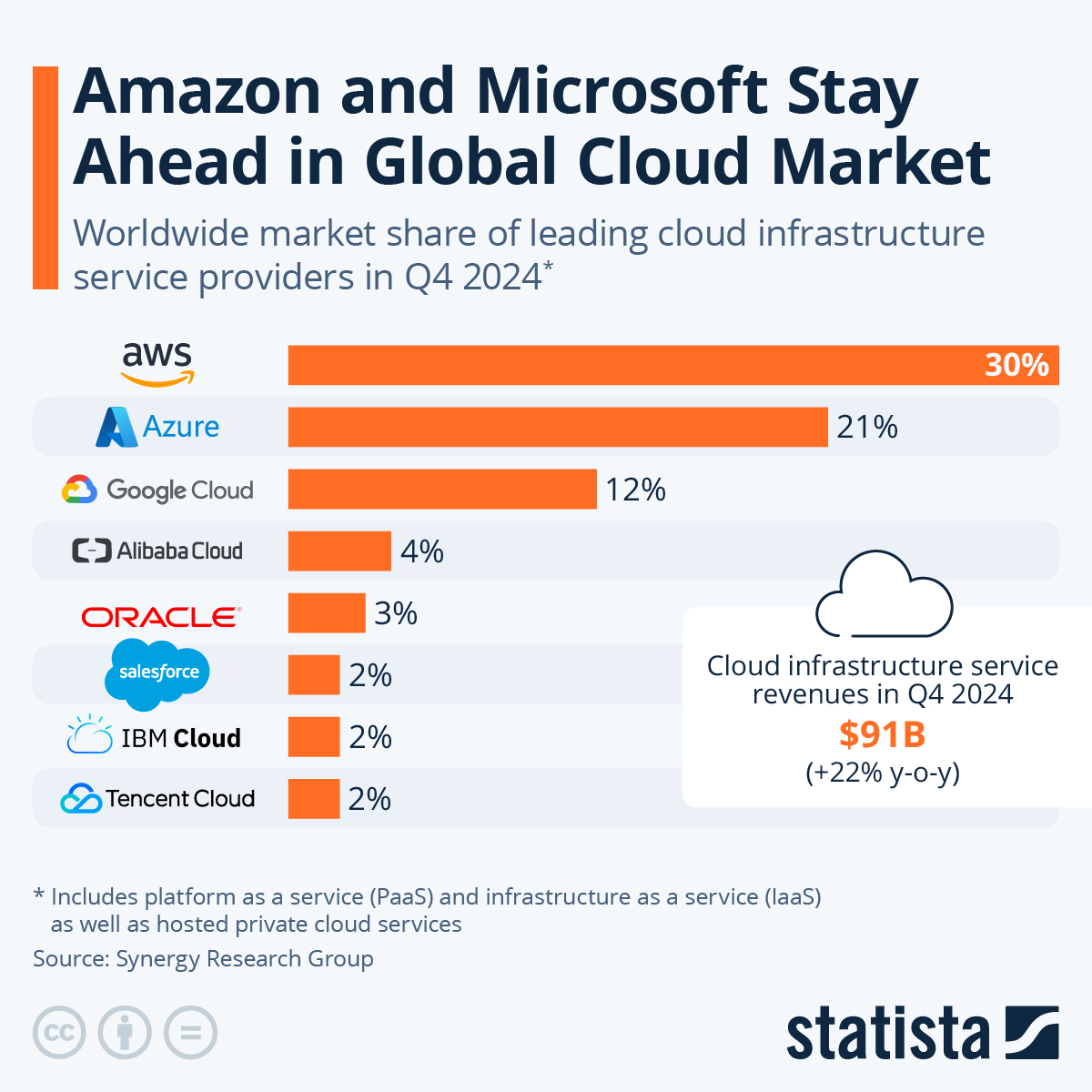
According to Synergy Research Group, Amazon Web Services, Microsoft Azure, and Google Cloud collectively command over 60% of the global public cloud market. That includes infrastructure-as-a-service (IaaS), platform-as-a-service (PaaS), and hosted private cloud services. Alibaba Cloud, while not as dominant globally, is a major force in Asia and among the top 5 providers worldwide. Together, these four shape the cloud landscape and choosing between them means aligning your tech stack with the right strengths.
Amazon Web Services (AWS)
AWS was first to market in 2006 and still holds the largest global cloud share. It offers the widest service catalogue across compute (EC2), storage (S3), databases (RDS, DynamoDB), machine learning (SageMaker), DevOps and more. With data centres across nearly every continent, AWS gives you global scalability and deep customisation options. Its breadth is its greatest asset, though organisations without dedicated cloud operations teams may find the configuration overhead significant.
Microsoft Azure
Azure launched in 2010 and surged quickly thanks to Microsoft's enterprise reach. If your business already uses Windows Server, SQL, Office 365 or other Microsoft products, Azure integrates directly. It excels in hybrid cloud setups connecting on-premises systems to the cloud, and includes Azure Virtual Machines, Blob Storage and AI tools such as Azure Cognitive Services. Azure is also a leader in identity management, powered by Microsoft Entra ID.
Google Cloud Platform (GCP)
GCP launched in 2008 and built its reputation on data and AI tooling. It offers BigQuery for large-scale data queries, TensorFlow for machine learning and Google Kubernetes Engine (GKE) for container orchestration. GCP trails AWS and Azure in market share but leads on developer tooling for data engineering and ML.
Alibaba Cloud
Founded in 2009, Alibaba Cloud is the dominant provider in China and a leader across Asia-Pacific. It offers a full stack of cloud services: ECS (Elastic Compute Service), ApsaraDB for database management and MaxCompute for big data analytics. It aligns with major data compliance requirements in China and Asia-Pacific, making it the go-to choice for businesses targeting those markets. It has a strong track record in e-commerce infrastructure and supports digital transformation across emerging markets.
Key comparison: AWS vs Azure vs GCP vs Alibaba
|
Category |
AWS |
Azure |
GCP |
Alibaba Cloud |
|
Pricing models and cost management |
Flexible pricing: pay-as-you-go, Reserved Instances (up to 75%), Spot Instances (up to 90%), free tier. Complex cost structure may require third-party tools. |
Pay-as-you-go with Reserved, Spot, and Hybrid Benefit (up to 76% savings for Windows licenses). Complex licensing adds pricing confusion. |
Simplified pricing. Sustained Use Discounts (up to 30%) and Committed Use Discounts (up to 57%). Transparent and aggressive pricing. |
Cost-effective in Asia-Pacific. Offers pay-as-you-go, subscription, and preemptible instances. Pricing varies globally. |
|
Security and compliance |
Broad global compliance (e.g., GDPR, HIPAA, SOC 2). Offers IAM and encryption at all layers for strong access control. |
Strong compliance support for enterprise/government. Azure Policy and Defender simplify management. |
Default encryption and zero-trust model. Meets most global compliance standards. Built for simple, secure setup. |
Focused on Asia-Pacific compliance (e.g., MLPS 2.0, GDPR). Strong in-region, less familiar globally. |
|
Machine learning and AI |
Robust ML suite including SageMaker, plus prebuilt tools for vision, language, and forecasting. |
Integrated AI tools with ready-to-use APIs. Custom ML supported through Azure Machine Learning. Easy for Microsoft users. |
Strong AI tools: Vertex AI, TensorFlow, AutoML. Great for advanced, scalable ML projects. |
AI tools for real-world use: e-commerce, recommendation systems, bots. Includes Machine Learning Platform for AI (PAI). |
|
Support and SLAs |
Service-specific SLAs. EC2 offers 99.99% regional uptime and 99.5% instance-level SLA. Tiered credits for outages. |
Service-specific SLAs. VMs in different zones: 99.99% uptime; same zone: 99.95%. Single-instance starts at 95%. Offers service credits. |
Service-specific SLAs. Single Premium VM: 99.9% uptime; multi-zone: 99.99%. Offers financial credits for downtime. |
Service-specific SLAs. ECS offers 99.975% uptime for single zone; 99.995% for multizone deployments. |
|
Best for |
Maximum service breadth and global reach. |
Microsoft-depedent orgs and hybrid cloud setups. |
AI/ML and data-heavy workloads. |
Asia-Pacific market presence and e-commerce. |
Cloud platform comparison table
Pricing models and cost management
AWS
AWS offers multiple pricing models: pay-as-you-go, Reserved Instances (up to 75% savings), and Spot Instances (up to 90% off). It also includes a 12-month free tier and various long-term savings plans (AWS Pricing). However, its pricing structure can be hard to manage at scale. As Gartner states in its Magic Quadrant for Global Cloud Infrastructure-as-a-Service, AWS pricing is granular and often requires third-party tools for accurate forecasting and cost control.
Azure
Azure also uses pay-as-you-go pricing, with added benefits for Microsoft users through Azure Hybrid Benefit, which can cut costs by up to 76% when reusing Windows Server or SQL Server licenses (Azure Pricing). Azure supports spot and reserved pricing, but its pricing complexity - due to layered licensing and discounts - is a common challenge. Microsoft also claims that Azure is cost-effective for businesses running Windows-based workloads.
GCP
Google Cloud stands out for its straightforward and competitive pricing. It automatically applies Sustained Use Discounts (up to 30%) and offers Committed Use Discounts (up to 57%) without requiring upfront commitment. GCP also provides a generous free tier and $300 in credits for new users (GCP Pricing). GCP’s use of flexible contracts and aggressive discounts to win enterprise users.
Alibaba Cloud
If you’re focused on Asia-Pacific markets, Alibaba Cloud is hard to beat on price. It offers multiple models: pay-as-you-go, subscription, and preemptible instances, along with a calculator to help estimate costs. CAST AI highlights it as one of the most affordable options in the region. Globally, though, pricing may vary more depending on service and location.
Security and compliance
AWS
AWS supports a wide range of global compliance standards like GDPR, HIPAA, and SOC 2. It offers powerful tools like Identity and Access Management (IAM) and encryption at every layer. These give teams fine-tuned control over access and data protection - making AWS a reliable choice for businesses with strict security needs.
Azure
Azure is known for strong compliance support, especially for enterprise and government needs. Tools like Azure Policy and Microsoft Defender for Cloud make it easier to stay compliant while managing resources at scale, and everything connects smoothly with Microsoft systems.
GCP
Google Cloud uses default encryption and a zero-trust security model. It meets most global compliance standards and is known for making security easy to manage. Its architecture is a good fit for teams that need security by default without complex configuration. For startups handling sensitive data, Google’s security-first approach is appealing.
Alibaba Cloud
Alibaba Cloud is focused on regional compliance, particularly in Asia-Pacific. The platform details certifications like China’s MLPS 2.0, GDPR, and others relevant to local markets. It’s a solid option if you operate heavily in China or Southeast Asia, but international certifications may not be as broad or familiar to global enterprises.
Machine learning and AI capabilities
AWS
AWS offers a wide range of AI and ML tools for developers and enterprises. Its flagship tool, SageMaker, helps teams build, train, and deploy ML models at scale. AWS also includes prebuilt tools for language, vision, forecasting, and personalization, making it flexible for both experts and teams just getting started.
Azure
Azure AI is designed to be accessible and tightly integrated with Microsoft’s ecosystem. It provides ready-to-use APIs for vision, speech, language, and decision-making, while Azure Machine Learning supports building and training custom models. The platform is well-suited for businesses looking to add AI without heavy development overhead.
GCP
Google Cloud excels in AI with tools like Vertex AI, TensorFlow, and AutoML. It’s ideal for teams that want to experiment, build, and scale advanced ML models. GCP's deep learning support and flexible infrastructure make it a strong option for AI-first organizations.
Alibaba Cloud
Alibaba Cloud focuses its AI services on practical business needs, like e-commerce, search, recommendation engines, and customer service bots. It offers tools such as Machine Learning Platform for AI (PAI) and prebuilt models for visual and language tasks, especially useful for businesses in retail and Asia-based markets.
Support and service level agreements (SLAs)
AWS
AWS doesn’t offer a single, platform-wide SLA. Instead, it provides individual SLAs for each service. For example, EC2 (its VMs service) comes with a regional uptime guarantee of 99.99% and an instance-level SLA of 99.5%. If AWS doesn't meet these guarantees, customers receive service credits based on the length and impact of the outage, with longer outages eligible for larger credits.
Azure
Azure also defines SLAs per service. For VMs, Microsoft guarantees 99.99% uptime when at least two instances are spread across different availability zones. If the VMs are in the same zone, the guarantee drops slightly to 99.95%. Single-instance SLAs vary by configuration but always start at a minimum of 95%. Like Amazon, Azure provides service credits when uptime falls below the guaranteed level.
GCP
Google Cloud links its SLA to each product. A single VM in the Premium Tier comes with a 99.9% uptime guarantee, which increases to 99.99% if deployed across multiple zones. Like others, Google provides financial credits if uptime falls below the guaranteed thresholds.
Alibaba Cloud
Alibaba Cloud sets different SLAs for each of its services, and the exact uptime guarantee often depends on how the service is deployed. For example, its Elastic Compute Service (ECS) guarantees 99.975% monthly uptime for single-instance setups, and up to 99.995% when spread across multiple zones.
Before selecting a provider, assess your workload types, budget, team's technical capacity and compliance requirements. Consider whether you need intensive data infrastructure or simple web services; whether you need regional coverage in Asia or Europe; and whether you want managed services or prefer direct control. If your current platform is also due for a change, cloud provider selection and replatforming are best tackled together rather than sequentially.
Choosing the right cloud platform for your business needs
Selecting the right cloud provider isn't just about who offers the most services; it's about finding the perfect fit for your business goals. Whether you're prioritizing cost savings, regulatory compliance, top-notch performance, or expanding your global reach, each platform brings its own unique strengths to the table.
What to consider before you choose
Before diving in, take a good look at your workload types, budget, your team's technical skills, and any compliance requirements. Are you running intensive data applications or just simple web services? Do you need lightning-fast access in Asia or Europe? Will your team handle the infrastructure, or do you prefer more hands-off, managed services? Answering these questions will point you toward the best match.
When AWS makes sense
AWS suits organisations that need the widest possible service catalogue, established global infrastructure and a large community of certified engineers. It is the default choice for teams that have not yet narrowed their requirements and want flexibility to scale in any direction. The trade-off is operational complexity: AWS typically requires dedicated expertise to manage costs and configuration at scale.
When Azure is the right fit
Azure is the practical choice for organisations already running Microsoft workloads. If your environment includes Windows Server, SQL Server, Microsoft Entra ID or Microsoft 365, Azure reduces integration effort and enables licence reuse through Hybrid Benefit. It is also the strongest option for regulated industries in Europe that need government-grade compliance coverage.
When to pick GCP
GCP is suited to engineering teams building data pipelines, ML models or analytics-heavy applications. BigQuery, Vertex AI and Google Kubernetes Engine are consistently rated among the best-in-class tools in their categories. GCP's pricing is the most transparent of the four, with automatic discounts that do not require upfront commitment.
Why choose Alibaba Cloud
If your operations are concentrated in China or across Southeast Asia, Alibaba Cloud offers the most established regional infrastructure and compliance alignment with local regulations, including MLPS 2.0. For businesses entering those markets, it removes significant setup friction that Western providers cannot match.
Conclusion: Build with confidence in the cloud
The right cloud platform depends on your workload type, regional requirements, existing technology stack and internal capacity to manage infrastructure. AWS offers the most breadth; Azure integrates most easily with Microsoft environments; GCP leads on data and AI tooling; Alibaba Cloud is the strongest choice for Asia-Pacific operations.
If you are evaluating platforms before a migration or looking to optimise an existing cloud setup, Niteco's cloud engineers can assess your environment and recommend the right configuration. We support clients across AWS and Azure with 24/7 proactive monitoring, a median response time of under six minutes and first-level ticket resolution without escalation.
Frequently asked questions
GCP typically offers the most transparent pricing due to automatic sustained-use discounts. Alibaba Cloud is the most cost-competitive for Asia-Pacific deployments. AWS and Azure offer more complex pricing structures with more configuration options, which can result in lower costs when managed correctly.
AWS and Azure serve different needs. AWS offers the broadest service catalogue and global reach. Azure is better suited to organisations already using Microsoft products. Neither is objectively better; the right choice depends on your existing stack and operational requirements.
GCP is generally considered the strongest for AI and ML workloads, particularly with tools such as Vertex AI, BigQuery and TensorFlow. AWS SageMaker and Azure Machine Learning are strong alternatives with broader ecosystem integration.
Yes. Niteco's cloud engineers advise on platform selection, migration planning and ongoing managed support across AWS and Azure environments.