


Top 9 Contentful CMS best practices for technical experts and developers


Contentful is a headless CMS built on an API-first architecture. Unlike traditional platforms where content and presentation are tightly coupled, Contentful stores content centrally and delivers it to any channel through its API, whether that is a website, mobile app, digital signage, or voice interface.
That flexibility makes Contentful a strong choice for organizations with complex content needs. But the platform only performs as well as the implementation behind it. Content models, API usage, media handling, and environment management all require deliberate technical decisions. Get those wrong, and you are left with a slow, fragile, or expensive setup regardless of what the platform can theoretically do.
This article draws on the experience of a Contentful-certified professional at Niteco who has delivered Contentful implementations for multiple enterprise clients. As a Silver Contentful partner with 29 certified experts, Niteco has implemented Contentful across a range of industries. The practices below reflect what actually works at scale.
What is Contentful CMS
Contentful is a headless content management system. Content is created and managed in a central repository, then served via API to any downstream application or channel. This separation of content from presentation is what distinguishes headless platforms from traditional CMS tools.
Key benefits of the headless approach
- Omnichannel delivery: publish once, distribute to websites, apps, IoT, and any API-connected surface
- Developer flexibility: teams choose their preferred frontend framework and tooling
- Scalability: cloud-native infrastructure handles growing content volumes and global traffic
- Content reuse: modular content types reduce duplication and simplify updates across channels
- Integration ecosystem: connects to commerce platforms, analytics, marketing automation, and AI services via API
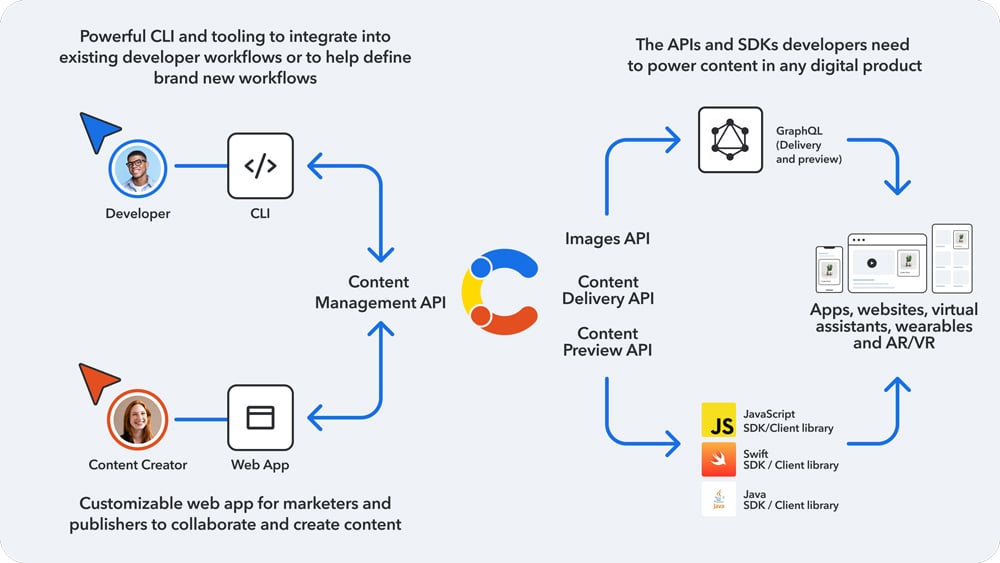 Manage your content with Contentful APIs
Why technical expertise matters in Contentful CMS implementation
Stepping into the world of headless with Contentful unlocks a treasure trove of benefits:
- Omnichannel delivery: Content can be easily distributed across various platforms and devices (websites, mobile apps, smart displays, etc.) through its API, ensuring a consistent brand experience everywhere.
- Developer flexibility: Developers have the freedom to use their preferred programming languages, framework, and tools for the frontend. Contentful supports this flexibility with comprehensive resources like quick start guides, videos, and tutorials tailored to various popular tech stacks.
- Scalability and performance: Built on a modern cloud infrastructure, Contentful is highly scalable to handle growing content needs and delivers content quickly and reliably to end-users globally.
- Content structure and reusability: Content is organized into modular, reusable components, making it easier to manage, update, and repurpose information across different channels, saving time and ensuring consistency.
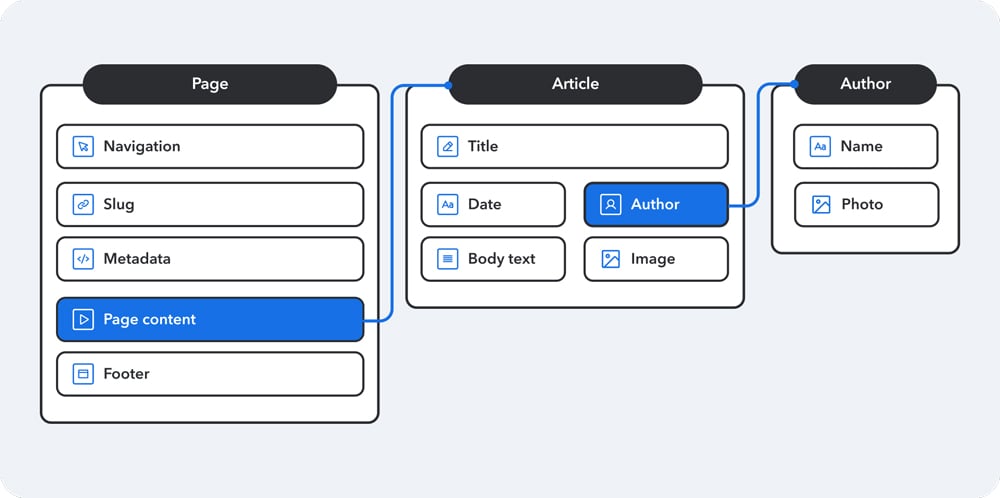 A structured content tree
- Extensive integration capabilities: Contentful seamlessly integrates with a wide range of other tools and services, such as Commerce platforms, marketing automation systems, analytics tools, and AI-powered services, creating a powerful and connected digital ecosystem.
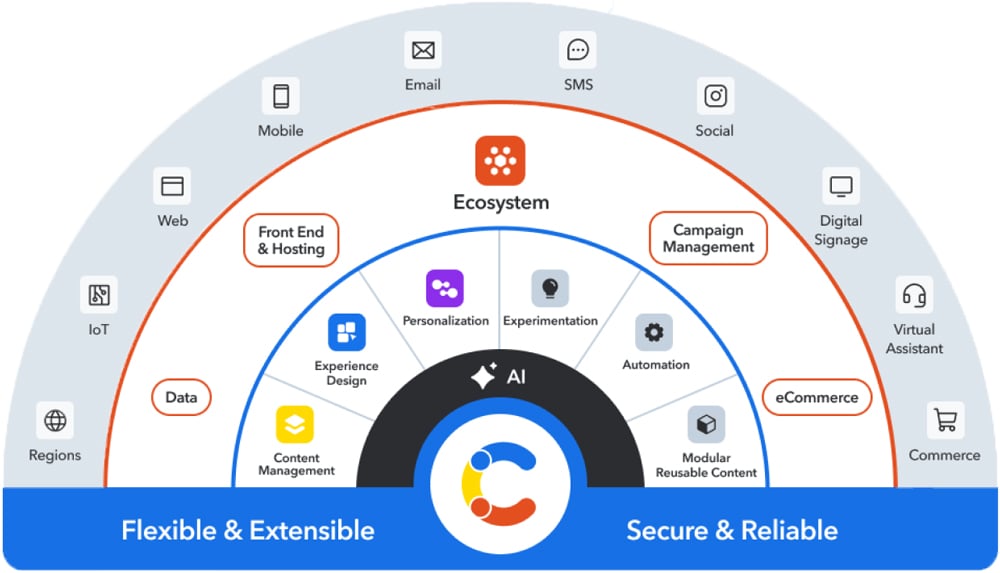 Contentful ecosystem
Why technical expertise matters in Contentful CMS implementation
Contentful's interface is accessible to editors and marketers. But the decisions that determine whether an implementation performs well, scales reliably, and stays maintainable are made at the technical level.
Technical teams are responsible for designing content models, building API integrations, configuring environments, managing media assets, and setting up automation. These are not optional configuration tasks. They directly affect editorial velocity, page performance, and long-term maintenance cost.
The nine practices below cover the areas where technical decisions have the highest impact.
Top 9 Contentful CMS best practices for developers
1. Leverage Contentful's CDN for content delivery
Contentful delivers content through a global Content Delivery Network (CDN) by default, serving data from the server nearest to the end user. Applications should be built to take full advantage of this setup. Caching API responses at the CDN layer, setting appropriate cache-control headers, and minimizing unnecessary re-fetches are the primary levers for consistent, low-latency content delivery at scale.
2. Use GraphQL for efficient data retrieval
Contentful supports both REST and GraphQL APIs. GraphQL is generally the better choice for content-rich frontends because it allows the client to specify exactly what fields it needs, reducing payload size and eliminating over-fetching. This has a direct effect on load times, particularly on mobile and lower-bandwidth connections.
3. Manage multiple environments
Contentful supports up to 151 environments per space (source: Contentful documentation). Use distinct environments for development, staging, QA, and production. This separation lets teams test content model changes or new features without touching live content. It also supports structured deployment workflows where changes are validated before they reach production, reducing risk on release days.
4. Design reusable, flexible content types
Content types are the foundation of a Contentful implementation. Poorly designed types create technical debt quickly: editors hit limitations, developers write workarounds, and content becomes duplicated or inconsistent across channels.
Design content types to be modular and semantic from the start. Separate structural concerns (page layout) from content concerns (copy, media, metadata). Plan for reuse across brands, locales, and channels rather than designing for a single use case.
5. Enforce consistent naming conventions
Consistent naming conventions for content types, fields, and assets are one of the simplest practices to establish and one of the most expensive to retrofit. Teams working across a Contentful space benefit significantly from agreed naming standards. This applies to API names (which are harder to change after go-live) as much as display names.
6. Manage and optimize media assets
Contentful's asset management tools allow teams to upload, organize, and deliver images and video files across channels. Structure your asset library with clear folder conventions and tagging from the start.
Use Contentful's Images API to serve assets at appropriate dimensions and formats for each context. Serving oversized images is one of the most common sources of avoidable page weight on Contentful-built sites.
7. Optimize asset delivery: compression and lazy loading
Compress images before upload to reduce file size without visible quality loss. Apply lazy loading to off-screen assets so they do not block initial page rendering. Contentful's Images API also supports Low-Quality Image Placeholders (LQIP), which can be generated via the API and displayed while full-resolution images load. This technique reduces perceived load time and is particularly effective on image-heavy pages.
8. Use webhooks to automate workflows
Contentful webhooks trigger actions in external systems whenever content changes. Common applications include cache invalidation, CI/CD pipeline triggers, and notifications to editorial teams. Webhooks reduce manual steps in publishing workflows and help keep downstream systems synchronized with content changes in real time.
9. Use Contentful's built-in productivity tools
Contentful Merge lets teams move content model changes between environments without manual re-configuration. This is useful when promoting updates from development or UAT to production.
Contentful Compose provides a page-level editing interface for editors who need to manage nested content structures. Contentful Launch enables coordinated publishing of multiple related content items in a single action, reducing the risk of partial publishes or editorial errors.
When Contentful no longer fits: signs it may be time to replatform
Contentful is a strong platform for many use cases, but it is not the right fit for every organization at every stage of growth. Some teams reach a point where the platform's architecture, pricing model, or capability set creates more friction than it removes.
Signs that a replatforming conversation may be warranted include:
- Editorial teams spending disproportionate time working around content model limitations
- API costs scaling faster than content value delivered
- Requirements for more sophisticated personalization, A/B testing, or commerce integration that require additional vendor relationships
- Organizational appetite to consolidate the digital experience stack onto a single platform
- Upcoming contract renewals that create a natural evaluation window
Niteco works with organizations at this decision point. Our replatforming service covers the technical migration, content transfer, and performance optimization required to move from Contentful to a platform better suited to evolving needs. Learn more about Niteco's replatforming services.
Real-world examples
The following project illustrates how these practices apply in a live implementation. Niteco worked with a global beverage brand that was running on a legacy WordPress setup and needed to migrate to Contentful with extended capabilities beyond what the platform provides out of the box.
How we managed the project
With our CMS implementation experience, we applied Contentful’s composable content model to create structured, reusable content types. This allowed editors to manage and publish content efficiently and consistently.
For added out-of-the-box capabilities integration, we have a clear approach and smooth implementation.
- Event Expiration Reminder: Using Contentful’s API-first architecture, we implemented an Azure Function to automate content reminders, enhancing editorial oversight.
- DAM integration: We built a custom Contentful App to connect to Aquia DAM. Editors can browse and select approved media assets directly within Contentful.
And the outcomes?
We introduced a structured content architecture including clear separation between pages and blocks, each based on defined types:
- Blocks are reusable content units stored and versioned independently or as part of a page
- Pages assemble these blocks, supporting templating and inheritance for efficient reuse.
We also implemented hierarchical URLs to address the challenge of Contentful’s flat content structure, providing SEO-friendly paths without compromising flexibility.
And finally, we made multibrand theming and templating for the client.
- Frontend: A shared core with theme-based overrides lets each brand customize its look (fonts, colors, layout) while reusing a unified codebase.
- Backend: Page and block templates dynamically adapt styling based on brand theme, ensuring design consistency across multiple sites.
'The whole project has been top-notch and the quality you've delivered is fantastic!' - That's the feedback we got from our client after implementing our Contentful-based solutions.
As a Silver Contentful partner with 29 certified experts, we know the platform inside out. We’re eager to help your business fully leverage the platform.
Conclusion
Getting Contentful right requires more than following setup guides. The decisions made at the architecture level, how content types are structured, how the API is queried, how environments are managed, and how media is optimized, determine whether the platform delivers long-term value or accumulates technical debt.
The nine practices in this article provide a practical foundation. They are applicable whether you are starting a new Contentful implementation or reviewing an existing one for performance or scalability gaps.
For organizations evaluating whether Contentful remains the right fit, or considering a move to a platform with broader digital experience capabilities, we outline how our approach to CMS migrations with a fixed timeline and performance-first methodology can bring your site up to the latest standards.
Contact Niteco to discuss your Contentful implementation or to explore your replatforming options.
FAQs about Contentful CMS and best practices
Contentful is a well-regarded headless CMS for teams that need to publish content across multiple channels from a single managed repository. Its API-first architecture suits organizations with complex frontend requirements or multi-channel distribution needs. Whether it is the right choice depends on your team's technical capacity, content volume, integration requirements, and budget.
The default environment in Contentful is typically named “master.” This serves as the primary environment for your live, published content. Users can also create additional environments (e.g., development, staging) for testing and content workflows before publishing to “master.”
Contentful's limits vary by plan. Commonly referenced limits include content types, locales, API requests, and asset storage. Plan tiers and their specific limits change periodically. Check Contentful's current pricing page for accurate, up-to-date limits before making platform decisions based on specific thresholds.
Best practices include leveraging Contentful's extensive API-first approach and webhooks. Use the Content Delivery API (CDA) for fetching content and the Content Management API (CMA) for managing it. Implement webhooks to trigger actions in other tools (e.g., build new deploys, clear caches, send notifications) whenever content changes.
To optimize performance:
- Implement a CDN (Content Delivery Network): For fast asset delivery.
- Cache API responses: Reduce repetitive calls to Contentful APIs.
- Use efficient queries: Fetch only the content you need, leveraging “include” and “select” parameters.
- Optimize images and media: Compress and serve them in appropriate formats.
Key security measures include:
- Strong API key management: Never expose management API keys client-side.
- Role-Based Access Control (RBAC): Assign minimal necessary permissions to users.
- Regular security audits: Review user roles and access settings.
- Use secure authentication methods: Implement SSO if available.
- Keep SDKs and libraries updated: To benefit from security patches.
- Monitor API usage: Detect unusual activity.
Contentful itself is highly scalable on the backend. Structure content models carefully, use modular content types, implement localization strategies early, and plan for content versioning and multi-environment workflows to support long-term growth.