


What is omnichannel content delivery? How AI-first DXP power omnichannel experience


Quick answer: Omnichannel content delivery is the practice of creating content in one structured and centralized model and delivering it to every touchpoint through APIs. Each channel draws from one source of truth, so a single update reaches your website, app, email and AI assistants without being rewritten. An AI-first DXP adds the shared customer data and governance that keep those channels coordinated rather than parallel.
A customer compares two washing machines on your website and saves one to a wishlist. She walks into a store where the display screen shows a different price and a spec sheet from two releases ago. She asks a staff member, who checks the app and finds a third version. Every channel is working as built. They were just built separately and updated manually.
For an enterprise running several markets, languages and brands, that is an operating model problem calling for an omnichannel content delivery solution. This article covers what omnichannel content delivery means, how AI has transformed it, how DXPs power omnichannel experiences through a structured content model, and a readiness diagnostic you can run on your own platform.
What is omnichannel content delivery?
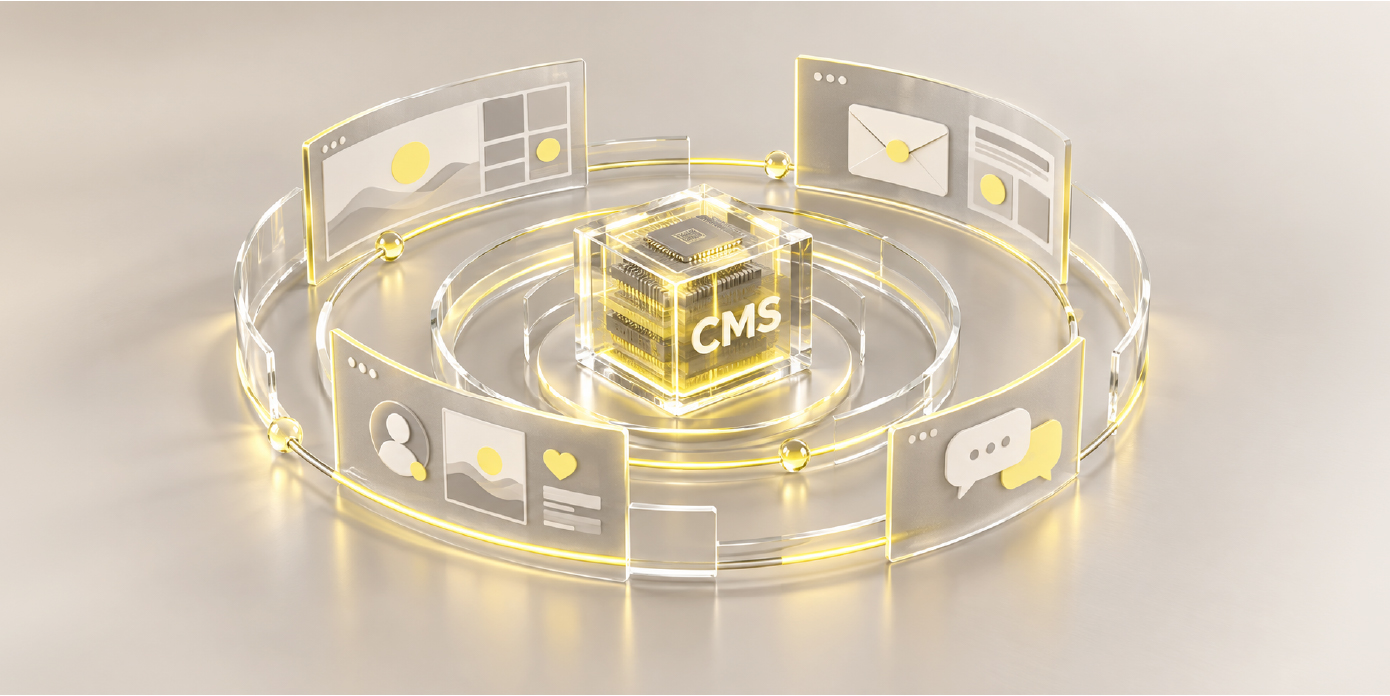
Omnichannel content delivery means managing content in one structured model and distributing it to every channel a customer uses, so experience stays consistent as they move between channels. Content lives independently of any presentation layer. Each channel requests only the fields it needs and renders them in its own way.
People often confuse omnichannel with multichannel. Multichannel means your content is present everywhere but fragmented. Omnichannel means it is consistent everywhere. Most enterprises have the first and assume they have the second.
McKinsey found that more than half of customers engage with three to five channels on the way to a single purchase or resolution. Fragmented content will create friction at every one of those handoffs, which stall this journey.
| Criteria | Multichannel content delivery | Omnichannel content delivery |
| Source of truth | Each channel holds its own copy | All channels read on one structured source |
| Customer view | Separate per channel | Unified and shared across all channels |
| Adding a channel | New building and content backlog | New front end consuming existing content |
| Content updates | Repeated manually per channel | Published once, delivered everywhere |
What counts as a channel at enterprise scale is broader than most content models assume: website, mobile app, email, social media, marketplaces, partner portals, in-store screens and kiosks, chatbots, AI assistants, and whatever arrives next. Omnichannel content delivery is what stops adding new channels and content updates from requiring more resources to execute.
How AI transforms omnichannel experience
First, AI is turning omnichannel experiences from a coverage and consistency focus to an orchestration and personalization focus. According to McKinsey, 71% of consumers expect personalized interactions and 76% become frustrated when those interactions do not happen. Platforms now read live behavioral signals, adjust messaging and offers as customer intent changes, rather than following a fixed journey map.
Second, AI chat have become a new delivery channel in their own right, reading and summarizing your content for your customer before they reach your own sites. Similarweb recorded average monthly visits across generative AI platforms growing 70% year over year to 9.5 billion between June 2025 and May 2026. Orchestrating content between AI discovery and traditional channels becomes a new omnichannel challenge.
Third, agentic AI is transforming the e-commerce scene by autonomously performing shopping tasks on your customer’s behalf. McKinsey's agentic commerce report highlighted that companies must rethink their engagement channels to be optimized for machine readability, not just human browsing. Keeping products discoverable now requires embedding semantic and behavioral metadata into product content.
All three shifts converge on the same requirement. AI can only orchestrate what it can read, and it can only personalize what it can connect to a customer. That means content structured as data rather than as pages, and a customer profile that stays consistent as someone moves between your site, an assistant and an agent.
How DXPs power omnichannel content delivery
So what does a platform need to have to power an omnichannel experience? It combines five capabilities in one system: composable architecture, API-first delivery, unified customer data, dynamic personalization, and centralized workflows and governance.
Most content management systems (CMS) provide the first two. A digital experience platform (DXP) provide all capabilities, turning parallel publishing into a coordinated experience.
- Composable architecture: Content, commerce, data, and personalization operate as services that can be assembled and replaced independently, so adding a channel does not mean building the stack around it.
- API-first delivery: Any front end can request content without waiting on a customer endpoint. At enterprise scale, a query layer matters more than plain content API.
- Unified customer data: Personalization is only enabled in omnichannel when customer profiles are shared. Without a common profile, you get per-channel personalization that is fragmented and inconsistent.
- Dynamic experimentation: Content variants and test run at the delivery layer so they apply across channels.
- Centralized workflows and governance: Approval chains and market-level permissions that hold across channels. Audit trails that answer who published what, when, and where. This is what makes sure content reuse is safe instead of risky.
A good DXP assembles these five capabilities in one stack rather than leaving enterprises to integrate them. For instance, Optimizely provides Optimizely Graph that handles API-first delivery and Optimizely One that connects customer data with experimentation.
At the same time, the Content Marketing Platform (CMP) covers the workflow layers and governance. CMP's omnichannel editor lets teams build an asset once against channel-specific content models, preview and publish everywhere in a single action. We cover that workflow in detail in How Optimizely CMP enables omnichannel content at scale.
What makes a structured content model?
Platform capability is necessary but not sufficient for omnichannel content delivery. Enterprises need to define the content model that is tailored to their business. Three content modeling decisions determine whether the platform can actually deliver.
- Modular design. Break pages into components. A product description, a price, a disclaimer and an image are separate objects, each reusable on its own.
- Channel-agnostic setup. Fields hold meaning, not formatting. Nothing in the model should assume a screen size, a template or a layout position.
- Metadata and taxonomy. Consistent tagging, clear entity relationships and stable canonical sources. This lets a system find the right content and makes your content legible to AI engines rather than something they have to infer.
Is your CMS ready for omnichannel content delivery?
To assess if your current CMS can power omnichannel experience, simply answer these questions:
- Can you publish a change once and have it appear in every channel?
- Can a developer retrieve any content item through an API without a custom endpoint?
- Does a customer recognized in the app stay recognized on the website?
- Can you launch a new market without duplicating the content tree?
- If an AI assistant answered a question about your product today, would it get the facts right?
If most answers are no, replatforming is a sound solution. Before any platform conversation, it is necessary to identify which type of platform your enterprise is using: traditional CMS, headless CMS, hybrid CMS or DXP.
Our breakdown of how traditional, headless, hybrid, and composable CMS architectures differ will help you decide whether you need a replatforming.
Migrate to a platform that delivers everywhere
Omnichannel content delivery can go wrong if enterprises fall into the platform migration pitfalls. Platform migration usually run through four stages: AI site analysis, content model creation, design and UI creation, then content migration.
The most important point is that the structured content model has to be designed before anything is moved. Skipping that step carries the old page-shaped constraints into the new platform.
| Stage | What happens |
| AI site analysis | Crawl and assess the existing estate: what exists, what is duplicated, what is orphaned |
| Content model creation | Design the structured, channel-neutral model the new platform will run on |
| Design and UI creation | Build the design system and component library against that model |
| Content migration | Map, transform and move content into the new structure |
The assumption that stops most teams is that this means a long rebuild project. It does not have to. At Niteco, this is the process our replatforming teams run daily. For legacy migrations of typical complexity, we bring sites live in 8 to 12 weeks depending on project scope.
As the world’s largest Optimizely partner, with more than 2,000 Optimizely projects delivered, we built an AI-powered Migration Machine that analyzes sites, generates content models and moves content automatically.
Besides, we assess AEO and GEO readiness within the migration scope rather than after launch. The operational side is covered in our walkthrough of how Optimizely CMP delivers omnichannel content at scale.
Conclusion
Omnichannel content delivery is a content architecture decision before it is a platform purchase: manage content once, in a structured and channel-neutral model, and deliver it everywhere from one source of truth.
An AI-first DXP does not simply distribute content further. It orchestrates: reading live behavioral signals, assembling personalized experiences per channel, generating market variants from one structured source, and exposing content in a form AI assistants can retrieve accurately.
If you are weighing whether your platform can support omnichannel content delivery at enterprise scale, our team can assess your CMS landscape and content model.
FAQs
Omnichannel content delivery is the practice of creating content once in a structured, channel-agnostic model and delivering it to every touchpoint through APIs. Each channel draws from the same source of truth, so one update reaches the website, app, email, marketplace and AI assistant without being rewritten.
A DXP combines structured content, API-first delivery, unified customer data, personalization and centralized governance in one platform. A DXP coordinates content distribution between channels that share a customer profile, so personalization follows the customer between touchpoints.
Ask whether one content change appears everywhere automatically, whether developers can pull any content item through an API, whether a customer recognized in your app stays recognized on your website, and whether an AI assistant would state your product facts correctly. Several no answers point to a platform migration.
Traditional enterprise replatforming runs for months. Niteco’s Migration Machine brings legacy migrations of typical complexity live in 8 to 12 weeks, with content modeling, design system creation and SEO continuity inside that scope.
to transform your business and drive results?
