


What is a Digital Experience Platform (DXP)? A complete guide for enterprise leaders


A Digital Experience Platform (DXP) is an integrated software system that enables enterprises to create, manage, and optimize personalized digital experiences across multiple channels such as web, mobile, apps, and commerce. If you’re asking what is a digital experience platform or DXP meaning, the simplest answer is: a DXP is the evolution of a CMS built for omnichannel, data-driven, and AI-powered customer experiences.
Unlike traditional content systems, a DXP connects content, customer data, personalization, analytics, and commerce into one coordinated ecosystem. This is why enterprises are increasingly adopting DXPs - to deliver consistent experiences at scale while improving speed, relevance, and operational efficiency.
In short: a DXP is not just where content lives. It’s how digital experiences are built, adapted, and optimized continuously.
In Brief
|
What is a Digital Experience Platform (DXP)?
A digital experience platform explained simply is this: it is the system that connects all the tools needed to deliver a complete digital journey.
From a business perspective, a DXP ensures customers receive consistent, relevant experiences across every touchpoint - whether they are browsing a website, receiving an email, or completing a purchase.
From a technical perspective, a DXP is a layered architecture that integrates multiple systems:
- Content management systems (CMS or headless CMS)
- Customer data platforms (CDP)
- Personalization engines
- Analytics tools
- Commerce systems
- Automation and AI services
This is why DXP meaning is often tied to broader concepts like customer experience platforms and composable architecture.
A simple way to understand it:
- A CMS manages content. A DXP manages the entire experience around that content.
- And that shift is the reason DXPs have become central to modern enterprise architecture decisions.
Key features of a digital experience platform
A modern DXP software solution is not a single tool. It’s a connected ecosystem of capabilities that work together.
Most enterprise DXPs include the following core functions:
- Content management: At the foundation is enterprise content management - creating, storing, and publishing content across channels. Many DXPs build on or integrate with headless CMS architectures to enable flexibility.
- Personalization: This is where DXPs go beyond CMS. Personalization engines tailor experiences based on behavior, location, and customer data. This is central to modern customer experience platform strategies.
- Experimentation: Leading platforms allow teams to test variations of content, layouts, and journeys. For example, Optimizely Opal integrates AI-assisted experimentation and decision-making into workflows.
- Analytics & insights: DXPs collect and unify behavioral and performance data, helping teams understand what works and what doesn’t.
- Commerce integration: For enterprises with eCommerce operations, DXPs connect product discovery, checkout, and transactional systems into the experience layer.
- Automation & AI: Automation handles workflows like content approvals, while AI increasingly powers recommendations, content generation, and optimization.
- Composable architecture support: Modern DXPs often support composable architecture, allowing enterprises to assemble best-of-breed tools instead of relying on a monolithic suite.
In practice, this turns a DXP into an experience orchestration layer, not just a publishing tool.
Why enterprises use digital experience platforms
Enterprises rarely invest in a DXP because they want another platform. They invest because the economics of disconnected digital experiences eventually stop making sense.
What used to work - a CMS, a few marketing tools, analytics, and some integrations - starts creating friction instead of growth.
That shift is showing up in customer expectations and business performance data.
Customers now expect personalization as a baseline - not a premium feature
One of the clearest drivers behind DXP adoption is the rising expectation for personalized digital experiences. According to McKinsey, 71% of consumers expect companies to deliver personalized interactions, and 76% become frustrated when those experiences don’t happen. Companies with stronger personalization capabilities also derive 40% more revenue from those activities than slower-growth competitors.
That changes the role of digital platforms.
Personalization is no longer about showing a different homepage banner.
It increasingly means being able to:
- recognize users across channels
- adapt content dynamically
- coordinate journeys across touchpoints
- respond to customer signals in near real time
This is difficult to achieve when content, data, and delivery systems operate independently. DXPs emerged largely to solve that coordination problem.
Operational efficiency becomes a growth lever - not just a cost-saving initiative
Another reason enterprises adopt DXPs is speed. Not website speed, it’s organizational speed.
As digital ecosystems expand, teams often inherit fragmented workflows:
- Marketing creates content in one system
- Commerce operates in another
- Customer data lives elsewhere
- Development teams become the integration layer for everything
The result is slower launches, duplicated effort, and rising technical debt.
A DXP reduces operational drag by creating shared workflows and connected experiences across teams. That matters because digital leaders increasingly compete on execution speed, not just roadmap ambition.
Omnichannel delivery has become operationally mandatory
Customers rarely interact with brands through a single touchpoint anymore.
They browse on mobile, compare on desktop, receive emails, interact with support, and purchase elsewhere.
But customers don’t think in channels. They think in experiences.
Research suggests customer experience is increasingly linked to commercial performance: 73% of companies with above-average customer experience outperform competitors financially, while consistent cross-channel engagement also increases customer willingness to spend.
That puts pressure on enterprise architecture.
A DXP helps organizations move from:
Multiple channels managed independently
to:
One experience delivered consistently.
AI readiness increasingly depends on connected experience architecture
Many organizations are racing to introduce AI. But AI rarely creates value in isolation.
Its impact depends on whether customer data, content, workflows, and decision systems are connected.
Recent research shows AI investment continues to rise, yet outcomes still lag. While enterprises are accelerating AI adoption, only 26% have successfully moved beyond experimentation to generate measurable value at scale, highlighting that execution - not intent - remains the biggest barrier.
That is one reason modern DXPs increasingly position themselves as orchestration layers - not simply content systems.
Because AI performs better when experiences, not just models, are connected.
Scalability becomes easier when digital complexity stops compounding
As organizations expand into new markets, brands, and channels, complexity often grows faster than demand.
Without a coordinated experience layer, every new initiative becomes another integration project.
DXPs help enterprises scale content, governance, and delivery through reusable workflows instead of rebuilding operations each time growth happens. Gartner reports that highly composable organizations can deliver new features up to 80% faster than competitors - showing the advantage of scaling on flexible foundations rather than adding complexity.
That’s often the hidden business case behind DXP adoption:
- Not launching more experiences.
- Launching them without multiplying complexity.
Examples of leading digital experience platforms (and what they’re actually best at)
When enterprises evaluate a DXP, the decision rarely comes down to feature checklists. On paper, most platforms look similar. In reality, they differ in philosophy, architecture, and how they shape teams and delivery speed.
Below is a practical way enterprise architects and digital leaders often interpret the landscape.
Optimizely One - Built for continuous experimentation and growth-led digital teams
Optimizely One is often recognized as an experimentation-first DXP but what makes it consistently appear in enterprise evaluations is not experimentation alone.
Optimizely has been recognized as a Leader in Gartner’s Digital Experience Platforms Magic Quadrant for six consecutive years, which signals sustained maturity across execution and platform vision. That recognition matters because DXP decisions are rarely short-term technology purchases, they are long-term operating model decisions.
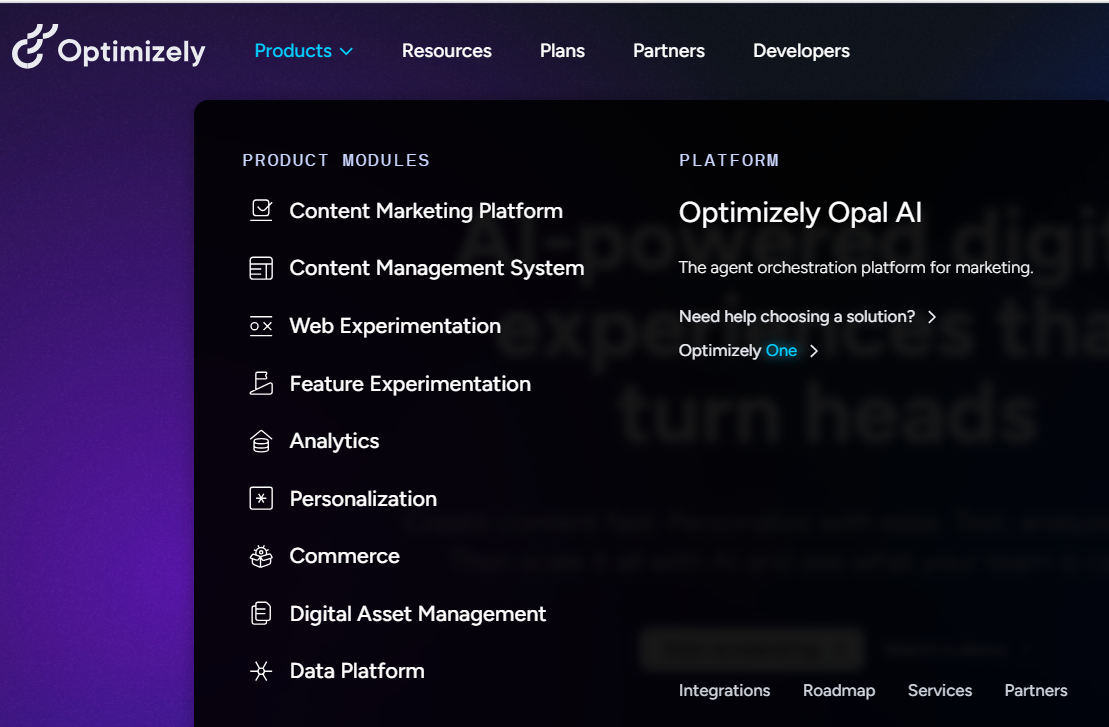
At platform level, Optimizely brings together:
- Content management (CMS)
- Content marketing and campaign workflows
- AI-assisted workflows through Optimizely Opal
- Experimentation and optimization
- Personalization capabilities
- Commerce functionality
- Enterprise governance and usability controls
More recently, Optimizely has extended this optimization approach into AI discovery through its partnership with Conductor, bringing AI visibility insights into Optimizely Analytics and helping teams understand how content is surfaced across answer and generative search experiences. Combined with Opal AI capabilities, this reflects a broader shift in digital experience strategy: optimization is no longer only about clicks and traffic, but increasingly about being discovered, cited, and recommended by AI.
What makes the platform stand out in practice is how these capabilities are connected.
Instead of: Publish → Wait → Analyze → Improve
Teams move toward: Create → Experiment → Learn → Optimize continuously
| Best suited for | What it really optimizes for |
|
Growth-focused enterprises, multi-market organizations, and digital teams that view optimization as an ongoing capability rather than a campaign phase. |
Reducing friction between content operations and experience optimization. |
Source: Optimizely
Adobe Experience Cloud - Enterprise-scale orchestration and ecosystem standardization
Adobe sits at the other end of the spectrum: it is less about agility in isolated teams and more about governed scale across large organizations.
Enterprises typically choose Adobe when they need to unify:
- Customer data at enterprise level
- Marketing automation and campaign orchestration
- Analytics across multiple business units
- Commerce and journey personalization
Its biggest strength is not a single feature - it’s the ability to act as a standardization layer across global operations.
That also explains its trade-off: complexity is higher, but so is control.
| Where it fits best | The real differentiator |
|
Large enterprises with multiple brands, regions, and governance requirements that demand consistency more than flexibility. |
It excels when the challenge is not “can we build experiences?” but “can we align hundreds of teams around one experience system?” |
Contentful - Composable content infrastructure for modern digital ecosystems
Contentful is not trying to be an all-in-one experience suite. Instead, it focuses on something more foundational: content as infrastructure.
It is built for organizations adopting composable architecture, where systems are intentionally decoupled:
- Content is delivered via APIs
- Frontends are independent of backend systems
- Teams reuse content across multiple channels
- New tools can be integrated without platform lock-in
This makes Contentful especially powerful in ecosystems where flexibility matters more than bundled functionality.
However, it also means enterprises need to assemble other components (personalization, experimentation, analytics) separately.
| Where it fits best | The real differentiator |
| Digital-first organizations, product-led companies, or enterprises actively moving toward composable stacks. | It removes content from the constraints of a single experience layer and turns it into reusable digital building blocks. |
More about Top 9 Contentful CMS best practices for technical experts and developers
Umbraco - Practical enterprise CMS with flexibility and developer control
Umbraco is often underestimated in DXP conversations, but in enterprise evaluations, it plays a very specific role.
It is typically chosen when organizations want:
- A reliable CMS foundation.
- Full control over .NET-based architecture
- Lower system complexity compared to large suites
- Editorial usability without heavy operational overhead
It doesn’t try to compete as a full experience suite. Instead, it acts as a stable content backbone that can be extended into a broader DXP ecosystem.
| Where it fits best | The real differentiator |
| Enterprises that already have strong internal architecture capability and want flexibility without adopting heavyweight enterprise suites. | It provides structure without forcing a full ecosystem shift - making it a pragmatic stepping stone toward more composable setups. |
How enterprises know they’ve outgrown their current digital platform
Most enterprises don’t decide to adopt a DXP overnight. It starts with friction.
Publishing slows down. Systems stop talking to each other. Personalization becomes manual. Launching new initiatives starts to feel heavier than it should.
Common signals include:
- Content workflows depend heavily on IT
- Customer data is fragmented across tools
- Personalization is inconsistent or manual
- Expanding into new markets takes too long
- Technical debt grows with each new initiative
- At this point, the issue is rarely just the CMS.
- It becomes a broader architecture constraint.
And the question quietly shifts from:
“Do we need a new platform?”
to
“What is preventing us from scaling digital experience effectively?”
That shift is usually the real starting point of a DXP conversation.
Moving from DXP strategy to execution
Defining a DXP strategy is relatively straightforward. Executing it inside real enterprise environments is where complexity appears.
A successful transition typically involves:
- Architecture planning across legacy and modern systems
- Migration from CMS or fragmented platforms
- Integration with data, commerce, and personalization systems
- Ensuring scalability, governance, and performance
- Establishing long-term optimization workflows
This is where implementation becomes critical - not as a technical delivery step, but as a bridge between strategy and reality.
Niteco supports enterprise organizations across leading DXP ecosystems including Optimizely, Adobe, Contentful, and Umbraco.
As the world’s largest Optimizely partner, with deep expertise in Optimizely One, Niteco works with enterprises on architecture planning, migration readiness, and implementation across complex digital ecosystems.
But the real objective is not implementation itself. It is ensuring the platform becomes a stable, scalable foundation for long-term digital growth.
Conclusion
A Digital Experience Platform is not just a CMS upgrade - it is an enterprise architecture decision that shapes how digital experiences are delivered, optimized, and scaled.
Understanding what a DXP is, how platforms differ, and when enterprises outgrow existing systems helps organizations make better long-term decisions about digital transformation and replatforming.
If you're evaluating your next step in digital experience maturity, the real question is not which platform to choose - but how to ensure it can support your future growth.
Frequently asked questions
A Digital Experience Platform (DXP) is an integrated system that enables enterprises to deliver personalized digital experiences across multiple channels. It combines content management, data, personalization, analytics, and commerce into one ecosystem.
A DXP manages the full digital experience lifecycle, including content delivery, personalization, experimentation, analytics, and integration with commerce and data systems to ensure consistent customer journeys.
A CMS manages content creation and publishing. A DXP manages the entire customer experience, including personalization, omnichannel delivery, analytics, and journey orchestration across multiple systems.
Enterprises use DXPs to enable personalization at scale, unify customer data, improve omnichannel delivery, increase operational efficiency, and accelerate digital transformation initiatives.
Common examples include Optimizely One, Adobe Experience Cloud, Contentful, and Umbraco. Each serves different needs, from experimentation-led growth to enterprise orchestration and composable architecture.
A business should move to a DXP when its current systems limit scalability, personalization, or speed of digital execution. Common signs include fragmented tools, slow publishing workflows, and increasing technical debt.
to transform your business and drive results?
