


DXP personalization strategy: Why most enterprise rollouts underdeliver - and how to fix it


In brief
Most enterprise personalization programs do not underdeliver because the technology is weak. They underdeliver because the work around the technology is unfinished.
A strong DXP personalization strategy starts with real customer problems, not platform features. It connects the right data, gives teams reusable content, makes experimentation part of everyday work, and focuses on a small number of high-value journeys before trying to personalize everything at once.
The goal is not to make every customer feel like the website knows their life story. It is to make each interaction more useful, timely, and easier to complete.
Personalization is easy to buy and surprisingly hard to make useful.
Many enterprises invest in a powerful DXP, connect a few data sources, launch a tailored homepage banner - and then the momentum fades. Marketing still needs development help for simple changes. Customer data is scattered. And the “personalized” experience is often just a different hero image for a few audience segments.
The platform is rarely the problem. More often, the organization has not yet built the habits around it: connected data, reusable content, clear ownership, and a steady rhythm of testing and learning.
That is why personalization should not be treated as a feature to turn on. It is a capability to build.
What DXP personalization really means
At its best, DXP personalization uses customer context, data, content, and experimentation to make digital experiences more relevant.
That could mean helping a first-time visitor find the right product faster. It could mean showing an existing customer useful support content before they open a ticket. Or it could mean recognizing that someone has already downloaded three resources on a topic, so there is little value in offering them the same beginner’s guide again.
In other words, good personalization helps people make progress.
This is where a DXP can go further than traditional CMS personalization. A CMS may allow teams to swap a banner, promote an article, or show different content to a defined segment. Helpful, certainly. But DXP personalization can connect content, behavioral signals, customer data, experimentation, and decisioning across multiple channels and journeys.
The distinction matters because customers do not experience a business one web page at a time. They move between marketing content, product pages, commerce journeys, service portals, emails, mobile experiences, and sales conversations. They expect those moments to make some kind of sense together.
McKinsey found that 71% of consumers expect companies to deliver personalized interactions, while 76% become frustrated when those interactions do not happen. That does not mean customers want brands to be overly familiar or follow them around the internet like an eager golden retriever. It means they notice when a company ignores useful context it already has.
Why enterprise personalization rollouts underdeliver
The pattern is familiar. A business buys a capable platform, gets excited about personalization, and then struggles to turn that promise into meaningful results.
Usually, the problem is not a missing feature. It is one of the following.
1. The team starts with technology, not a customer problem
DXP demos can make personalization look wonderfully straightforward. Pick an audience, add a rule, change a component - done.
But the hard question arrives after the demo: What should we personalize first, and what customer problem will it solve?
Without a clear answer, teams tend to start with whatever is easiest to configure. That often means homepage banners, broad industry segments, or regional variations. These can be useful early steps, but they rarely create meaningful impact on their own.
- A better place to start is with a specific point of friction:
- Are first-time visitors struggling to find the right product or service?
- Are returning visitors seeing the same content over and over?
- Are high-intent buyers dropping off before requesting a demo or quote?
- Are customers turning to support because self-service content is difficult to find?
- Are regional teams rebuilding campaigns that should be reusable?
Once the problem is clear, the right data, content, and experience become much easier to define.
2. The organization personalizes pages, not journeys
A personalized homepage is fine. But it is only the front door.
If the rest of the journey is slow, confusing, repetitive, or generic, the value disappears quickly. Changing the welcome mat does not help much if the hallway is still a maze.
The more valuable opportunities often sit deeper in the experience:
- On-site search and content discovery
- Product or service recommendations
- Content sequencing for returning visitors
- Account and self-service journeys
- Forms and lead-generation flows
- Support experiences
- Renewal, cross-sell, or onboarding journeys
Imagine someone researching a complex enterprise solution. A personalized banner is a nice touch. More useful would be helping that person find the right use case, compare relevant options, access proof points for their industry, and take the next step without starting from scratch each time.
That is the difference between making a page look different and making a journey work better.
3. Customer data is everywhere - and nowhere useful
Most enterprises do not lack customer data. They lack a shared, reliable, usable view of it.
Marketing has campaign data. Commerce has transaction data. Sales has CRM records. Service teams have support history. Analytics has behavioral data. Regional teams may have their own systems, definitions, and spreadsheets quietly doing their own thing.
A DXP cannot solve that simply by sitting in the middle of the stack.
Data needs to be connected, governed, consented, and available when needed. Teams also need to agree on practical questions: Which signals are trustworthy? Who can create and manage audiences? What data should never be used for personalization? When does relevance become intrusive?
The goal is not to build a mythical, perfect customer profile. That project tends to last forever. The goal is to use trustworthy signals to make a few better decisions at the moments that matter.
4. Content was built for pages, not for reuse
Personalization needs content that can move.
If every asset is locked inside a one-off page layout, teams will struggle to create and test variations without calling in developers, designers, and an approval committee large enough to organize a small wedding.
Structured, modular content makes personalization more practical. Teams can reuse approved messages, product details, calls to action, imagery, and proof points across channels, audiences, and markets - without rebuilding everything from scratch.
This does not mean producing endless variations of every asset. It means creating content with enough flexibility to be relevant in more than one context.
5. Personalization is treated as a project with an end date
This might be the biggest issue of all.
Teams often approach personalization as a launch: configure the platform, build a few experiences, get approval, publish, celebrate, move on.
But customer behavior changes. Business priorities shift. Campaigns come and go. Content gets outdated. A good audience rule in March may be irrelevant by September.
Personalization is not a project to finish. It is a program to run.
The strongest teams have clear ownership, a prioritized backlog of ideas, a regular test-and-learn rhythm, and a way to decide which experiments deserve more investment. They also accept that not every test will win.
If every experiment has to be successful, people eventually stop testing anything interesting.
Explore: Personalization trends: Shaping the future of digital marketing
A practical personalization maturity model
Personalization maturity is not about how many platform features an organization owns. It is about what teams can do reliably, repeatedly, and without creating chaos behind the scenes.
| Maturity stage | What it looks like | Next priority |
| Broadcast | Most visitors see the same experience. Data is fragmented, content is page-based, and testing is occasional. | Establish reliable measurement, basic audience definitions, and priority use cases. |
| Rule-based | Teams use simple segments, such as location, lifecycle stage, industry, or referral source. | Move from isolated page changes to higher-value customer journeys. |
| Connected | Key data sources are connected, content is reusable, and teams run regular experiments. | Coordinate personalization across web, commerce, service, and marketing. |
| Orchestrated | Data, content, experimentation, and decisioning work together across channels with clear governance. | Scale proven experiences and optimize them continuously. |
There is no prize for racing to the final stage before the organization is ready. A well-run rule-based program can outperform an ambitious AI initiative that has unreliable data, no content model, and unclear ownership.
The best next step is usually the one that removes the organization’s biggest constraint.
How to build a DXP personalization strategy that actually scales
A scalable strategy does not begin with a giant audience matrix. It begins with a business goal and a customer journey worth improving.
Start with a small number of high-value journeys
Choose two or three journeys with a clear commercial or operational impact. For example:
- Improving product discovery for first-time visitors
- Reducing abandonment in a quote or demo-request journey
- Helping existing customers find answers without contacting support
- Increasing engagement with relevant content before a buying decision
- Supporting regional teams with reusable campaign experiences
These use cases should be important enough to matter, but focused enough to measure.
Define the signal, decision, and outcome
For each use case, ask three simple questions:
- What signal tells us something useful? For example, a visitor’s location, product interest, account status, referral source, or previous content engagement.
- What should change because of that signal? A recommended resource, a more relevant call to action, prioritized support content, or a different content path.
- What outcome are we trying to improve? Journey completion, qualified leads, conversion, self-service success, retention, or revenue per visitor.
This keeps personalization grounded in a reason for existing.
Make content operations part of the plan
If creating a new variation takes weeks, teams will not be able to keep up. Build reusable content components, clear workflows, and sensible approval paths from the beginning.
The goal is not to hand marketers unlimited control over sensitive data or complex logic. It is to let them make safe, timely changes without turning every experiment into an IT project.
Give the program clear ownership
Personalization sits across marketing, product, data, analytics, content, and technology. That is exactly why it can become everyone’s priority - and nobody’s responsibility.
A shared operating model works best:
- Marketing and product teams own customer use cases and business outcomes.
- Data and analytics teams validate signals, measurement, and learning.
- Technology teams provide secure, scalable foundations and integration support.
- Content teams create the modular assets that make relevant experiences possible.
- Everyone has a role. Someone still needs to own the program.
Treat experimentation as a habit, not a rescue plan
Personalization without experimentation is just assumptions delivered at scale.
Build a manageable backlog of hypotheses, prioritize them based on customer and business value, and test them against meaningful outcomes. Learn what works, keep what helps, and retire what does not.
McKinsey found that companies that grow faster drive 40% more of their revenue from personalization than slower-growing peers. That is not a promise that every personalization initiative will deliver a 40% uplift. It is a reminder that organizations that treat relevance as a serious, ongoing capability can create a meaningful advantage.
Measure outcomes, not activity
“We launched 12 personalized experiences” may sound productive. It does not say whether customers were better off. A useful scorecard should connect personalization work to customer and business outcomes.
| Area | Useful measures |
| Customer experience | Journey completion, search success, task completion, customer satisfaction, self-service resolution |
| Commercial performance | Conversion rate, qualified leads, revenue per visitor, average order value, renewal or retention |
| Content effectiveness | Engagement with recommended content, content progression, return visits, content reuse |
| Operational efficiency | Time to launch a variation, number of changes made without development support, experiment velocity |
| Program health | Data quality, audience accuracy, test cadence, adoption by marketing and product teams |
Be careful with engagement metrics. A higher click-through rate can be encouraging, but clicks are not the finish line. The real question is whether those clicks help someone take a useful next step.
How to choose the right DXP for personalization
The best DXP is not the one with the most impressive capabilities slide. It is the one that fits the organization’s maturity, operating model, and long-term digital strategy.
A personalization-ready platform should make it practical to:
- Connect trusted first-party data
- Define and manage audiences
- Create and reuse structured content
- Test and optimize experiences
- Deliver relevant content across channels
- Support marketers without creating governance headaches
- Integrate with the wider enterprise ecosystem
Optimizely DXP
Personalization can sound exciting in a strategy deck. In real life, it often gets stuck between disconnected tools, approval queues, and a campaign team asking, “Wait - which version are we using?”
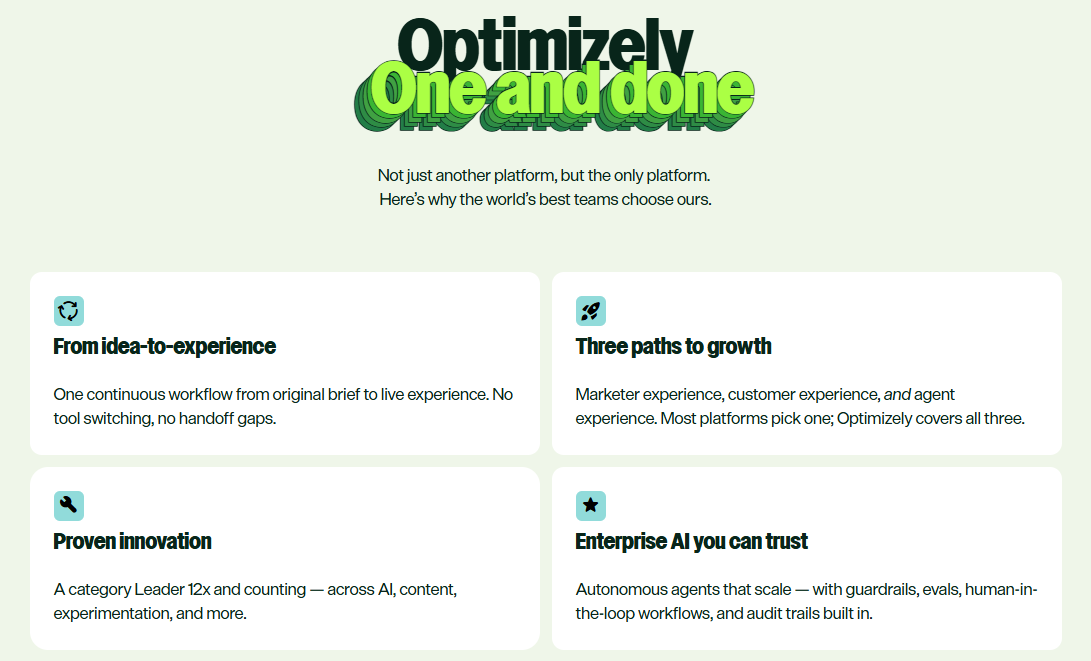
Optimizely One is designed to make that work feel far less painful. Named a Leader in the 2026 Gartner® Magic Quadrant™ for Personalization Engines, Optimizely gives enterprise teams a connected environment for creating, testing, and improving experiences that feel genuinely relevant - not just vaguely targeted.
Its CMS, CMP, DAM, and Experimentation capabilities work together, with Opal AI agents helping coordinate the busywork across content, campaigns, assets, and testing. The result is a smoother path from “we think this audience needs something different” to “let’s test it and see.”
That is where personalization starts to earn its keep: less guesswork, fewer handoffs, and more moments that help customers find what they need and move forward.
Source: Optimizely
Adobe Experience Cloud
Adobe Experience Cloud offers deep capabilities for organizations already invested in the Adobe ecosystem. Adobe Experience Platform, Adobe Target, and Adobe Analytics can support sophisticated data activation, decisioning, and measurement.
It can also require significant investment in integration, governance, and specialist skills. The platform is powerful, but it is not a shortcut around operational complexity.
Contentful
Contentful is a compelling choice for organizations that want flexible, composable, API-first content delivery. It works especially well where content needs to travel across multiple products, front ends, and channels.
Its flexibility usually means organizations will need to connect other tools for customer data, testing, and decisioning. That is not a flaw; it simply requires a clear architecture and a team prepared to manage it.
Read more: How to choose a digital experience platform (DXP): A practical enterprise selection framework
Turning personalization into a long-term capability
A new platform can make personalization easier. It cannot make the organization ready by itself.
That readiness comes from connecting data thoughtfully, building reusable content, creating clear governance, and helping teams develop the confidence to test and learn. It also means being realistic about AI. AI can speed up content work, identify patterns, support decisioning, and suggest next-best actions - but it still needs trustworthy data, good content, and human judgment.
Niteco helps enterprises build those foundations across Optimizely, Adobe Experience Cloud, Contentful, and Umbraco. As the largest global Optimizely gold partner, Niteco supports leading enterprises with DXP strategy, replatforming, data and content architecture, experimentation, and personalization programs designed for practical, long-term progress.
Niteco’s AI-powered Migration Machine can also reduce migration timelines by up to 75% in suitable projects - helping organizations get to a more flexible platform faster, without treating migration as the end goal.

Planning a replatform or personalization program? Explore Niteco’s Enterprise Replatforming Services.
Conclusion
Personalization does not become effective because more features are enabled.
It becomes effective when an organization can consistently use customer context to make an experience easier, more useful, and more relevant. That requires more than a DXP: it requires connected data, reusable content, clear ownership, thoughtful governance, and a willingness to keep learning.
Start small. Choose the journeys that matter. Test the ideas that could reduce real customer friction. Then build from what works.
That is how personalization stops being a polished demo and starts becoming a genuine business capability.
FAQs
A DXP personalization strategy is a plan for using customer data, content, experimentation, and decisioning to create more relevant digital experiences. It defines priority customer journeys, data sources, ownership, content requirements, measurement, and the technology needed to scale.
They often fail because organizations start with platform features instead of customer problems. Other common challenges include fragmented data, page-based content, weak governance, unclear ownership, limited experimentation, and treating personalization as a one-time launch rather than an ongoing program.
CMS personalization typically changes content on a website, such as a banner, article, or page component. DXP personalization is broader: it connects customer data, content, experimentation, and decisioning across web, commerce, service, and other digital touchpoints.
Useful data may include consented first-party behavioral data, customer lifecycle information, commerce activity, product interest, content engagement, account data, and service interactions. The priority is not collecting every possible signal - it is using reliable data that can improve a specific customer journey responsibly.
Enterprises should track customer and business outcomes, including ROI, journey completion, conversion, qualified leads, revenue per visitor, retention, self-service success, and time to launch or test new experiences. Engagement metrics can help, but they should not be treated as the final measure of success.
Yes. AI can help identify patterns, recommend content, support audience decisioning, speed up analysis, and assist with content creation. However, AI works best when it is supported by reliable data, reusable content, clear governance, and a well-defined personalization strategy.
A business should consider replatforming when its current platform makes it difficult to connect customer data, reuse content, run experiments, support marketers independently, or deliver relevant experiences without excessive custom development and maintenance.
to transform your business and drive results?
