


What is website replatforming? Enterprise guide to platform migration


Website replatforming is the process of moving a website, CMS, or eCommerce platform from one technology foundation to another to improve scalability, performance, security, and digital capabilities.
Enterprise businesses typically replatform when legacy systems begin slowing growth, limiting customer experience improvements, or creating operational inefficiencies behind the scenes. Modern website platform migration projects are no longer just about replacing outdated technology, they’re often tied to larger digital transformation goals like omnichannel experiences, composable architecture, AI readiness, and faster content operations.
In this guide, we’ll explain what website replatforming means, when companies should consider it, how the migration process works, common risks to avoid, and how enterprises can choose the right modernization strategy without turning the project into a multi-year horror story.
In brief
|
What is website replatforming?
Website replatforming means replacing the underlying platform powering your website with a new system that better supports business goals, operational needs, and future scalability.
In simple terms: you’re changing the engine, not just repainting the car!
A replatforming project may involve:
- moving to a new CMS
- replacing legacy eCommerce infrastructure
- shifting to cloud-native architecture
- adopting a headless CMS
- modernizing integrations across the martech stack
- rebuilding customer experience workflows
And unlike a simple redesign, replatforming affects both the technical and business layers of a digital ecosystem.
That’s why enterprise website replatforming projects usually involve multiple teams - not just developers quietly working in a corner while marketing waits for launch day.
Replatforming vs website redesign
A redesign changes how a website looks.
Replatforming changes how the website operates underneath.
Many organizations combine both initiatives into one project, but they solve different problems. A redesign focuses on UX and branding, while replatforming focuses on infrastructure, scalability, integrations, workflows, and long-term flexibility.
Replatforming vs CMS migration
CMS migration is often just one part of website replatforming.
For example:
- moving from one CMS to another = migration
- rebuilding architecture, improving integrations, modernizing workflows, and optimizing digital operations around that migration = replatforming
That distinction matters because enterprise replatforming is rarely just about content management anymore. It’s about creating a digital foundation that can support future growth without requiring twelve workarounds and a weekly emergency developer meeting.
Why enterprises replatform their websites
Most enterprises don’t wake up one morning excited to replatform their website.
Usually, the platform starts becoming a problem long before the replatforming conversation officially begins.
Pages take too long to launch. Integrations become fragile. SEO performance plateaus. Teams rely on patches instead of proper solutions. Every new feature request somehow turns into a six-week development project.
At some point, maintaining the current platform becomes harder than modernizing it.

How does the website replatforming process work?
Enterprise website platform migration projects are part technical transformation, part operational redesign, and part organizational therapy session.
Because once teams start mapping workflows, integrations, governance issues, and content structures, they usually discover problems that have been quietly hiding for years.
That’s normal.
A successful replatforming process typically follows several key stages.
1. Audit the existing platform
Before selecting a new platform, businesses need a clear understanding of the current environment.
This includes evaluating:
- technical debt
- site performance
- SEO issues
- integration complexity
- infrastructure limitations
- workflow inefficiencies
- customer experience gaps
The goal isn’t just to identify what’s broken.
It’s to understand what the business actually needs moving forward.
2. Define business goals
Replatforming without clear objectives is one of the fastest ways to create an expensive project with unclear outcomes.
Enterprise businesses should define goals around:
- scalability
- customer experience
- operational efficiency
- international growth
- personalization
- content velocity
- AI readiness
A platform should support business strategy - not become the strategy itself.
3. Choose the right platform
Different platforms solve different problems.
Some organizations prioritize:
- flexibility
- composable commerce
- headless CMS architecture
- omnichannel delivery
Others prioritize:
- integrated ecosystems
- governance
- experimentation tools
- operational simplicity
The “best platform” depends heavily on business maturity, internal capabilities, and long-term digital goals.
4. Plan data and content migration
This stage includes:
- content mapping
- URL planning
- redirect strategy
- customer data migration
- media transfer
- taxonomy cleanup
This is also where many migration issues begin if planning is rushed.
Because content tends to accumulate in surprising ways over the years. Old campaigns. Duplicate pages. Forgotten microsites. PDFs from 2017 nobody remembers uploading. Replatforming usually uncovers all of it.
5. Modernize the user experience
Many enterprises use replatforming as an opportunity to improve:
- navigation
- mobile usability
- accessibility
- conversion journeys
- personalization
- omnichannel consistency
A modern platform should make better experiences easier to deliver - not harder.
6. Protect SEO during migration
SEO migration planning is critical during website replatforming.
Poorly handled migrations can lead to:
- ranking losses
- broken pages
- indexing problems
- traffic declines
Key SEO activities include:
- 301 redirects
- metadata preservation
- technical SEO audits
- sitemap updates
- Core Web Vitals optimization
- canonical management
Done properly, replatforming can improve SEO performance significantly.
Done poorly… well, traffic charts become uncomfortable meeting material.
Read more: Website migration: Best practices and strategies for a seamless transition
7. Test before launch
Enterprise platforms involve a huge number of moving parts.
Before launch, teams typically conduct:
- QA testing
- integration testing
- accessibility testing
- security audits
- browser/device testing
- performance testing
Testing may not be glamorous, but it’s dramatically cheaper than discovering issues after launch.
8. Launch and continuously optimize
Replatforming doesn’t end when the site goes live.
Post-launch optimization often includes:
- performance monitoring
- SEO tracking
- UX improvements
- conversion optimization
- governance refinement
- operational adjustments
The best replatforming projects evolve continuously instead of treating launch day as the finish line.
What are the most common website replatforming risks?
Every website platform migration comes with risks. The good news is that most of them are preventable with proper planning and realistic expectations.
Common website replatforming risks include:
- Time and budget overruns - unclear project scope can quickly expand timelines and costs.
- Data migration issues - incomplete transfers may result in lost customer or content data.
- SEO traffic loss - broken redirects and technical SEO mistakes can affect rankings.
- Integration failures - CRMs, payment systems, and third-party tools may stop functioning properly after migration.
- Security and compliance concerns - mishandled customer data can introduce regulatory risks.
- Customer experience disruptions - downtime or broken experiences can impact conversions during rollout.
- Custom development complexity - legacy features often require unexpected rebuilding work.
Most migration disasters don’t happen because replatforming is inherently risky. They happen because organizations underestimate how interconnected modern digital ecosystems actually are.
Read Pitfalls in website replatform: Best practices for CMS migration

Choosing the right replatforming strategy
Not every enterprise needs a full rebuild from scratch.
In fact, some of the most successful modernization projects happen incrementally rather than through massive “replace everything at once” initiatives.
The right digital replatforming strategy depends on:
- business goals
- technical complexity
- operational readiness
- internal resources
- scalability requirements
Here are the most common approaches.
| Strategy | Best for | Complexity | Scalability | Typical timeline |
| Lift-and-shift | Fast modernization | Low | Moderate | Short |
| Full rebuild | Large transformation initiatives | High | High | Long |
| Headless CMS | Omnichannel experience | Medium-high | Very high | Medium |
| Composable architecture | Enterprise flexibility | High | Very high | Long |
| Incremental modernization | Lower-risk transformation | Medium | High | Medium |
Lift-and-shift
This approach migrates the website to a new platform while keeping most existing structures intact.
It’s faster and less disruptive, but it may also carry older inefficiencies into the new environment.
Think of it as moving houses without decluttering first.
Full rebuild
A full rebuild redesigns the architecture, workflows, integrations, and digital experience from the ground up.
This creates the most transformation potential - but also requires the highest investment and organizational alignment.
Headless CMS approach
Headless CMS architecture separates frontend presentation from backend content management.
Benefits often include:
- faster frontend development
- omnichannel delivery
- improved flexibility
- scalable digital experiences
This approach works particularly well for enterprises managing multiple customer touchpoints.
Composable architecture
Composable architecture allows businesses to assemble specialized tools through APIs rather than relying on one large monolithic platform.
This improves:
- flexibility
- adaptability
- experimentation speed
- integration scalability
But composable ecosystems also require stronger governance and technical coordination.
Incremental modernization
Some enterprises modernize gradually instead of launching one massive transformation project.
This approach reduces risk and allows organizations to prioritize the highest-impact improvements first.
Sometimes slower modernization actually produces faster long-term outcomes because teams can adapt progressively instead of trying to reinvent the entire digital operation overnight.
Best platforms for enterprise website replatforming
The best platform depends on your business model, operational complexity, scalability goals, and digital maturity.
And despite what every “top CMS list” online says, there’s no one-size-fits-all winner here.
Some platforms are built for enterprise governance and personalization. Others prioritize flexibility, composable architecture, or faster development workflows.
Here are several platforms commonly considered in enterprise website replatforming projects.
Optimizely
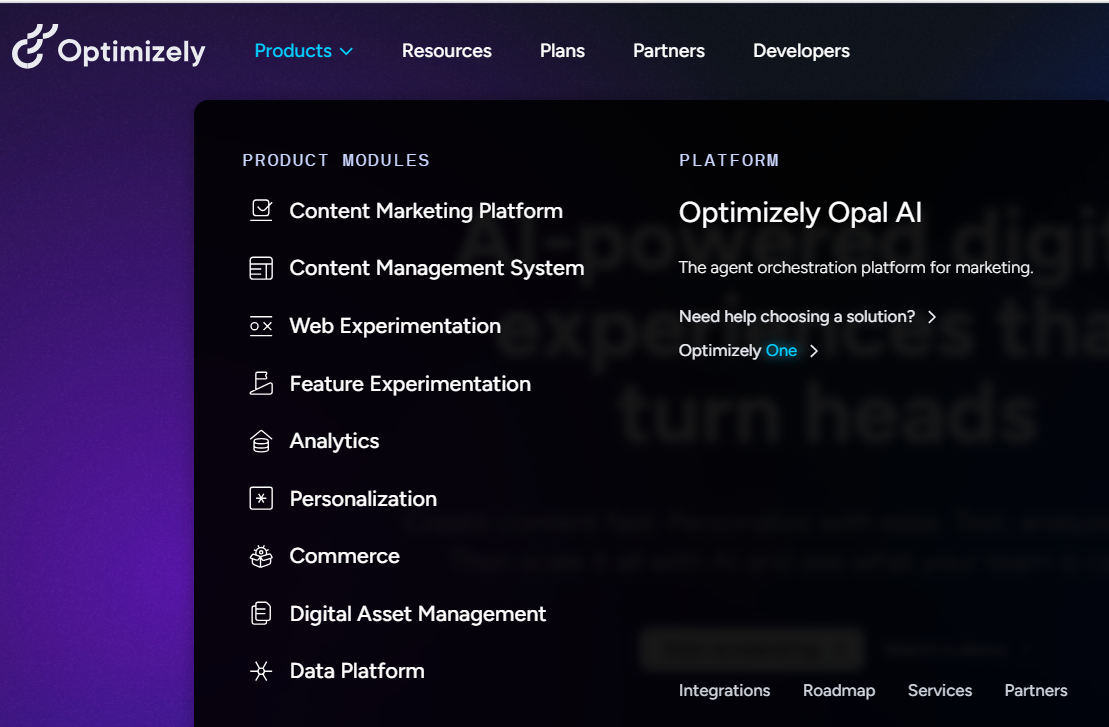
Optimizely is one of the industry-leading enterprise Digital Experience Platforms (DXP), Optimizely One, widely adopted across enterprise B2B, healthcare, manufacturing, and commerce organizations.
Its ecosystem combines:
- CMS
- experimentation
- personalization
- commerce
- CMP capabilities
into a more connected digital operating environment.
The platform has also expanded heavily into AI-powered workflows through Optimizely Opal, its AI assistant integrated across the DXP ecosystem to help accelerate content operations, experimentation, and marketing productivity.
For enterprises balancing scalability, governance, and customer experience optimization, Optimizely is often a strong modernization choice.
Source: Optimizely
Adobe Commerce
Adobe Commerce remains one of the most established enterprise commerce platforms globally, particularly for organizations with complex catalogs, multi-store operations, and advanced B2B requirements.
Its deep customization capabilities and integration with the Adobe ecosystem make it popular among large-scale commerce businesses - though implementation complexity can also be higher.
Contentful
Contentful is a widely adopted headless CMS platform known for its API-first approach and composable flexibility.
It’s especially popular among enterprises building omnichannel experiences across websites, apps, and multiple digital touchpoints.
Umbraco
Umbraco offers a flexible, developer-friendly CMS environment with a lighter operational footprint than some larger enterprise suites.
It’s often chosen by organizations looking for strong customization capabilities without excessive platform complexity.
Conclusion: Work with experienced migration partners
Enterprise website replatforming projects rarely fail because of technology alone. More often, problems appear during migration planning, integrations, SEO preservation, or operational rollout.
That’s why choosing the right implementation partner matters.
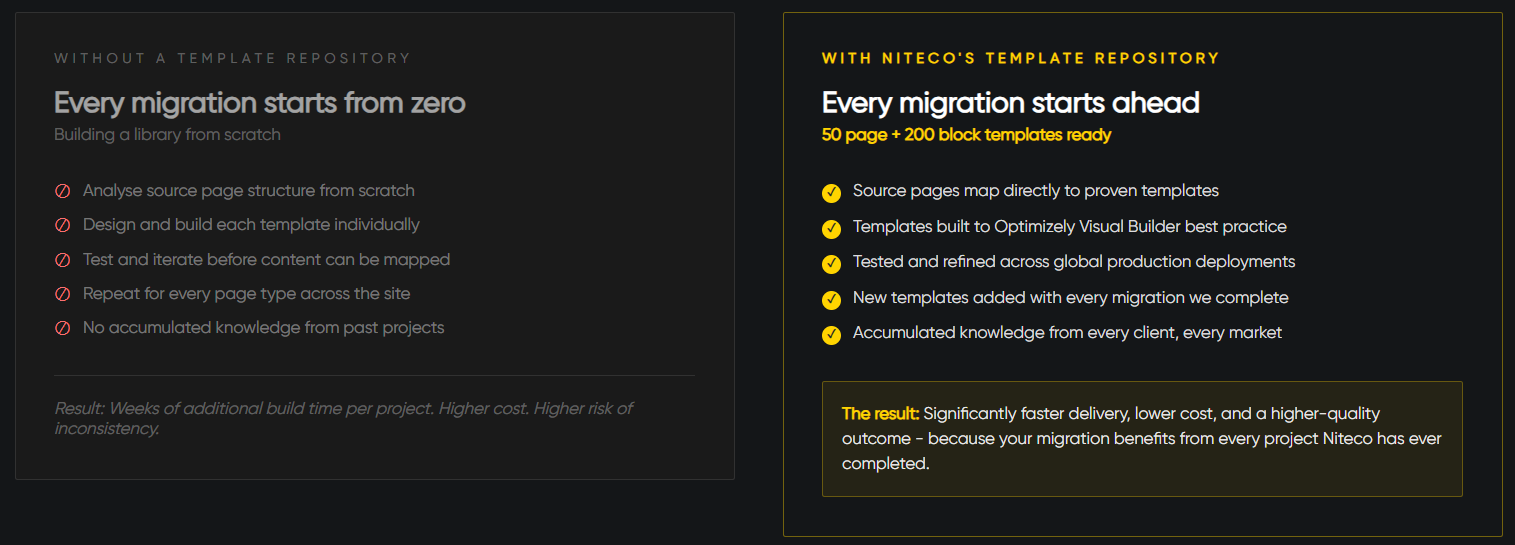
At Niteco, we’ve delivered 500+ migration and replatforming projects across enterprise CMS, commerce, and digital experience platforms.
As one of the world’s largest Optimizely partners - with certified expertise across Adobe, Contentful, and Umbraco ecosystems - our team includes 225+ certified experts specializing in enterprise modernization and migration strategy.
To help enterprises move faster, we’ve also built an AI-powered replatforming machine that can reduce migration timelines by up to 80% while improving scoping visibility through fixed-price assessments. That means projects that traditionally take months can sometimes be completed in as little as 8 weeks, NOT months!
FAQs about website replatforming
Website replatforming means moving a website, CMS, or eCommerce platform to a new technology foundation to improve scalability, performance, flexibility, security, or digital capabilities.
Website migration is a broader term that refers to moving website assets or infrastructure. Replatforming specifically involves changing the core platform powering the website.
Companies typically replatform when legacy systems create operational inefficiencies, scalability issues, poor customer experiences, increasing maintenance costs, or security concerns.
Enterprise website replatforming projects can take anywhere from several months to over a year depending on complexity, integrations, customization requirements, and organizational structure.
Yes. Website platform migration can impact SEO if redirects, metadata, URL structures, or technical SEO elements are mishandled during migration.
Common risks include SEO traffic loss, integration failures, data migration issues, budget overruns, security concerns, and customer experience disruptions during rollout.
to transform your business and drive results?
