


Sitecore vs WordPress: When to choose a DXP over an Open-source CMS


Quick answer
WordPress is an open-source CMS built to manage content, so it suits most single-market businesses with simple content operation. Sitecore is a DXP built to coordinate content, customer data, personalization, experimentation and commerce in one governed system. It earns its cost when you expand into new markets, operate under compliance obligations, or depend on knowing your customer across channels.
Choosing between Sitecore and WordPress is not really a question of which platform is better. It is a question of how much of your digital experience your business want to buy and how much you are willing to build and maintain yourself. This article helps you make the call: how Sitecore differs from WordPress, when to choose a DXP over an open-source CMS, and how to reduce the risk of a CMS migration when you do.
What are the differences between DXP with CMS?
To compare Sitecore and WordPress fairly, it helps to be clear that they aren't the same kind of product.
WordPress is a content management system (CMS) which creates, stores and publishes content: pages, media, templates and workflows. WordPress is the best known and by far the most used, at around 41% of all websites and close to 60% of sites running a CMS, according to W3Techs.
Sitecore is a digital experience platform (DXP) - an integrated system for creating, delivering and optimizing customer experiences across channels. It includes content management, personalization, customer data and analytics, experimentation, commerce integration, omnichannel delivery and governance, all in one platform. Other leading DXPs in the market include Optimizely, Adobe Experience Cloud, and Contentful.
The easiest way to differentiate them is a CMS is a tool, while a DXP is an operating model.
Almost every capability a DXP offers can be assembled on open-source CMS using plugins and custom development. What is hard to assemble is the coordination between them, for example, customer data moving from commerce to a separate CRM, then syncing into a personalization plugin.
That coordination is the work you take on yourself, and at the enterprise scale it becomes an operating expense rather than a technical detail. See what a DXP does that a CMS can’t to inform the right platform decision for your business.
Sitecore vs WordPress: Which is better?
Neither platform is better in the abstract. They are built for different operating contexts, and the honest comparison only works once you know which context you are in.
Here is how the two compare across criteria that matter most to enterprise teams.
| Sitecore | WordPress | |
| AI readiness | Native AI features across content and personalization, tied to platform data | Depends on third-party plugins and external tools, with no shared data layer |
| Content model | Structured and reusable across channels by design. | Page-based by default. Structured content needs custom fields or plugins |
| Personalization | Real-time, built in and tied to a single customer profile | Plugin-based. Each plugin holds its own visitor data |
| Multi-market | Native inheritance and shared content models across sites and languages | Multisite exists, but governance and inheritance have to be built |
| Scalability | Easy handles on high traffic scales. | Struggle with high traffic. Need costly upgrade from hosting company |
| Integration | Composable architecture of integrations, enabled by enterprise connectors plus an API layer. | Monolithic architecture, very large plugin ecosystem with variable quality and upkeep |
| Security model | Vendor-owned patching with one accountable party | Community and third-party vendors, with no single accountable party |
| License cost | Significant, subscription-based | No core license fee |
| Total cost of ownership | Higher upfront, more predictable | Lower upfront, more variable over time |
In short, Sitecore gives you a comprehensive digital experience in one place. WordPress gives you a content platform you extend with plugins.
Three categories below deserve a closer look, because that's where WordPress limitations show up most at enterprise scale.
Sitecore is AI-ready. WordPress has to be assembled for it
AI-driven discovery and automation require structured content and centralized customer data, connected in a coherent way. Gartner analyst Irina Guseva notes that content and data have generated themself under agentic AI, which is hard without consistent and structure architecture.
This has become a standard for Sitecore. On WordPress, each plugin holds its own content structure and its own copy of the customer. That is why WordPress estates end up with several partial views of the same person, and why getting content AI-ready usually means restructuring it first.
Sitecore owns your patching. WordPress distributes it
Sitecore ships with role-based access, approval workflows and audit trails as part of the platform, and patching is handled by one accountable vendor. On WordPress, that accountability is distributed across a community of independent plugin authors.
Patchstack's State of WordPress Security in 2026 recorded a 42% rise in vulnerabilities across the WordPress ecosystem in 2025, with 91% of them in plugins. WordPress core is not the weak point, its extension ecosystem is. The practical question is whether your organization can evidence a patching process fast enough to satisfy an auditor.
Less upfront cost doesn’t always mean better
One of the biggest business concerns over choosing Sitecore over WordPress is enterprise DXP cost, and license fees are the number most often compared and the least useful one to compare.
WordPress has no license fee but it has costs that arrive later: enterprise-grade hosting, premium plugin subscriptions, security tooling and monitoring, compatibility testing every time a plugin or core version changes. At enterprise scale, those add up to a figure often closer to a Sitecore subscription than the zero on the license line suggests.
When to choose Sitecore over WordPress
The clearest way to decide is to start with your business situation rather than a feature list.
When WordPress is enough
Most of the time, WordPress is sufficient for basic website needs.
- You operate in one market, one language, under one brand. Content is written once and published once, so there is no inheritance problem to solve.
- The customer relationship is owned by another system. Your CRM knows who the customer is, and the website does not need to. Personalization needs are basic.
- Your website is a shopfront, not a digital service channel. The commercial relationship completes in a sales conversation, a branch, or a separate commerce system.
- Content velocity matches your team. Campaign-led publishing that a small team handles without a backlog.
If most of these describe your business, choosing Sitecore will add cost without adding capability. The better investment should be placed in content and design.
When to switch to Sitecore
Here's when you've outgrown your WordPress and need to switch to Sitecore:
- You are expanding into new markets or languages. Growth across geographies turns content from a publishing task into a governance problem. The same proposition has to be localized in different languages, kept consistent with global brand and legal positions, and adapted where regulation differs.
- Your commercial strategy depends on knowing the customer. Retention and lifecycle marketing all assume a consistent view of the customer across web, email, commerce and support. That requires personalization tied to a unified profile, not four tools each holding a partial view.
- Digital is becoming a revenue channel rather than a marketing channel. Self-service, commerce and account management bring integration obligations across CRM, CDP and commerce that a brochure site never had.
- Organic discovery is shifting to AI answer engines. AI assistants cite content that is structured and consistent, which needs a platform designed for it.
- Content demand is growing faster than headcount. More markets, more channels, more variants, without more people. The answer is reuse and high-velocity variant creation, which agentic AI can handle under human guidance in a DXP.
When two or more of these describe your situation, the coordination that DXPs like Sitecore provides stops being overhead and becomes the cheaper and more time-saving option.
Which is the right DXP platform for your enterprise?
Once you know you need a DXP, the next question is which one. This is where many evaluations go wrong, because most enterprise DXPs now offer broadly the same capabilities.
According to CMSWire, when DXPs have reached capability parity, organizations should look past a bundle of features and focus on operational proof: orchestration across systems, integration patterns, governance and controls, telemetry and measurement, and whether the vendor can support a real operating model rather than an isolated content management tool.
Sitecore is not the only enterprise DXP, and for many organizations it is not the strongest fit with its performance issues. Among Sitecore’s alternative, Optimizely was named a Leader for the sixth time by the 2025 Gartner Magic Quadrant for Digital Experience Platforms, positioned furthest for completeness of vision and highest for ability to execute. Gartner credited Optimizely One for breadth and modularity, its consumption-based pricing, and its ability to integrate acquired technology without forcing wholesale adoption.
For teams prefer pricing predictability, a unified CMS rather than several, and native AI across content, personalization and experimentation, Optimizely tends to score well on the criteria above. If you are considering a DXP, our ultimate guide on choosing the right platform is a useful place to start.
Migration risk and de-risk re-platforming
Most businesses run an open-source CMS until their scale outgrows it, then CMS migration becomes essential. However, most replatforming projects fail for reasons that have little to do with the platform, such as data loss, loss of SEO ranking or integration failure. From our experience across a portfolio of clients, it’s usually a planning problem before it is a technical one, which is why the choice of implementation partner shapes the outcome as much as the choice of platform.
At Niteco, we work with enterprises whose platforms are across Optimizely, Adobe, and Contentful, with 400+ experts and more than 15 years of delivery. Our AI-powered Sitecore to Optimizely migration service uses an automated Migration Machine that handles content, assets and templates at scale, cutting migration time by up to 75% compared with traditional approaches. Our AI-powered migration accellerator ensures SEO and GEO equity preservation, performance optimization and parallel testing before cutover.
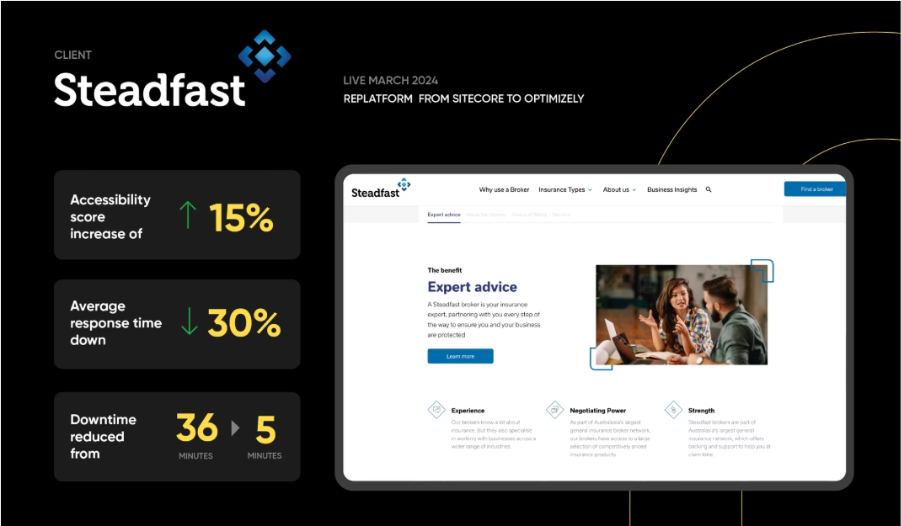
We helped Steadfast move from Sitecore to Optimizely in just eight weeks and used Optimizely's personalization features to lift click-through rate on recommended content by 286%.
Conclusion
Choosing a DXP or CMS eventually comes down to aligning your digital strategy with business objectives. WordPress is an excellent CMS for organizations in one market with simple content operations and shallow integration need, it remains the right and cheaper answer. A DXP earns its cost at a specific point: when governing content across markets, unifying customer data and integrating your commercial systems costs more to do manually than to license.
The mistake to avoid is treating this as a shortlist exercise. Score your real requirements first, be transparent about total cost of ownership on both sides, and plan the migration before you plan the launch. Enterprise replatforming only succeeds in preparation, and on the partner who does it with you.
Talk to our enterprise replatforming specialists to assess your current CMS landscape.
FAQs
to transform your business and drive results?
